
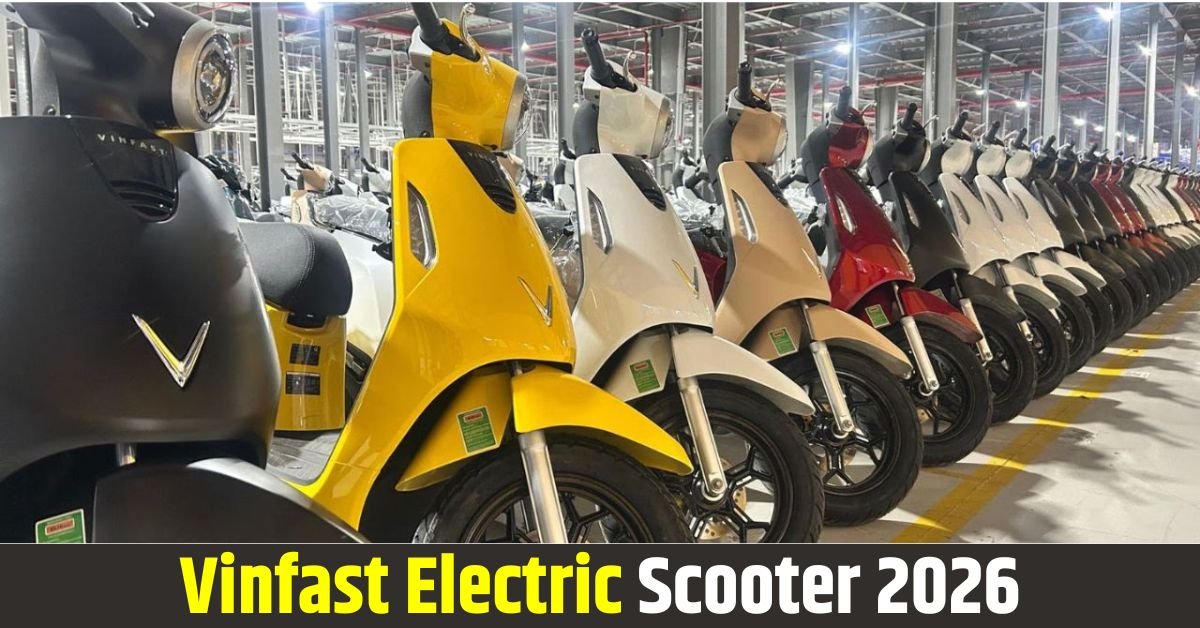

India’s electric two-wheeler market isn’t just crowded it’s a battlefield. Ola Electric and Ather Energy are fighting tooth and nail with old-school heavyweights like TVS and Bajaj for every last customer. But 2026 might be the year everything changes. And the curveball isn’t coming from Bengaluru or Pune it’s rolling in from Hanoi.
VinFast, Vietnam’s biggest EV player, has confirmed plans to enter the Indian market in 2026. That alone would make headlines, but the real story lies in how they plan to do it. Because this isn’t just a company launching a few scooters. It’s a complete ecosystem invasion.
The Hidden Dimension: VinFast’s “GSM” Trojan Horse
Every other EV maker in India fights for customers. VinFast brings its own.
In Vietnam, the company runs GSM (Green and Smart Mobility), a fully electric ride-hailing and taxi service powered entirely by its own scooters and cars. And according to multiple industry insiders, VinFast plans to roll out GSM in India soon after launching its vehicles here.
That’s a game-changer. Instead of waiting for retail buyers, VinFast can dump thousands of scooters straight into its own fleet from day one. Imagine it—VinFast scooters zipping around city centers, each one doubling as an advertisement, a test ride, and a sales pitch.
What’s more, VinFast uses what insiders call a “driver-salesman” model. Each GSM driver earns a referral commission for every customer they bring in. In short, every ride could become a sales opportunity.

That’s something Ola, Ather, and the rest simply can’t replicate. Their sales depend on consumer demand; VinFast manufactures its own.
The Pricing Gamble: “Battery-as-a-Service”
If there’s one move that could really rattle India’s EV giants, it’s VinFast’s pricing playbook.
In its home market, the company offers a Battery-as-a-Service (BaaS) model. Customers buy the scooter’s chassis at a lower price and rent the battery for a monthly fee. It’s the EV equivalent of a prepaid phone plan.
The implications for India? Massive. A scooter that usually costs ₹1.3 lakh could hit showrooms at around ₹75,000 or even less—making electric mobility accessible to middle-class families who’ve been priced out until now.
There’s also the issue of battery anxiety—fear of degradation and replacement costs. Under the BaaS model, VinFast owns the batteries, maintains them, and replaces them when needed. Buyers don’t have to worry about long-term performance or resale value.

That’s a win-win: cheaper entry cost, zero battery headaches, and lifetime support.
This approach could completely shift how Indians think about vehicle ownership. You’re no longer “buying” a scooter—you’re subscribing to mobility.
The Likely Contenders: VinFast’s 2026 Lineup
VinFast isn’t coming to India with one model—it’s bringing a full stack of options tailored to local market gaps. Based on their current Vietnamese lineup and design filings in India, here’s what to expect.
| Model | Segment | Range (km) | Top Speed (km/h) | Approx. Price (INR) | Key Competitors |
|---|---|---|---|---|---|
| Evo200 | Entry-level commuter | ~203 | 70 | ~₹75,000 | Ola S1 X, TVS iQube, Magnus Grand |
| Feliz S | Utility commuter | ~198 | 78 | ~₹1,00,000 | Vida VX2 Plus, Ola S1 Pro, TVS iQube ST |
| Klara S2 | Premium family scooter | ~194 | 78 | ₹1.2–2 lakh | Ather Rizta Z Pro, Bajaj Chetak 3501 |
| Theon S | Performance flagship | ~150 | 99 | ~₹1.95 lakh | Ather 450X, Ola S1 Pro Gen 3, TVS Orbiter |
Evo200: The Volume Disruptor
This one’s VinFast’s mass-market workhorse. The Evo200 runs on LFP (Lithium Iron Phosphate) batteries—known for better heat resistance and longer life than the NMC cells used by many Indian players. With a real-world range of around 150–170 km, it’s built to handle India’s city chaos without overheating or frequent charging.
This model is expected to populate the GSM fleet, giving it instant visibility and massive scale advantages.

Feliz S: The Practical Commuter
The Feliz S could be VinFast’s ace for semi-urban India. It’s bigger, sturdier, and sits on 14-inch wheels—unlike most Indian scooters that max out at 12 inches. That means better balance on broken roads and rural terrain.
It’s clearly designed for the “Hero Splendor” or “Honda Shine” crowd—riders ready to upgrade from petrol but unwilling to compromise on comfort and road presence.
Klara S2: The Family Retro
The Klara S2 blends retro-Italian looks with a modern EV heart. It’s for families who want a comfortable, reliable, and stylish scooter for daily use. VinFast has already filed design patents for this model in India, signaling serious intent to localize it.
With an LFP battery rated for over 2,000 charge cycles (that’s about 10 years of daily use), it promises exceptional durability—a quiet advantage over most local competitors.
Theon S: The Flagship Showcase
Finally, there’s the Theon S—VinFast’s performance scooter. It ditches the traditional hub motor for a central motor and chain drive setup, boosting acceleration and handling. Dual-channel ABS, smartphone key integration, and premium build quality make it a halo product designed to showcase the company’s engineering capabilities.

It won’t sell in huge numbers, but it’ll turn heads.
The Bigger Picture: A Closed-Loop Ecosystem
VinFast doesn’t think in isolation. In Vietnam, it doesn’t just build scooters—it builds the entire ecosystem around them: charging stations, financing arms, servicing hubs, even its own energy management systems.
That’s the masterstroke they’re planning to replicate in India. The Tamil Nadu facility, announced under a $500 million investment plan, is expected to serve as the nerve center for both manufacturing and ecosystem deployment.
If all goes to plan, VinFast could control everything from vehicle production and fleet operation to after-sales and financing. In an industry where fragmentation is the norm, that kind of vertical integration could be lethal to competitors.
The Countdown Begins
The big question: can India’s homegrown players defend their turf?
Ola and Ather have the brand recognition and local know-how. TVS and Bajaj have legacy networks. But VinFast has something none of them do—a battle-tested, vertically integrated system that manufactures its own demand.
For Indian incumbents, the next two years are going to be about one thing: fortifying their business models before the Vietnamese giant lands. Because once it does, the rules of the EV game could change overnight.
- VinFast’s India factory: Confirmed under a 2024 MoU with the Tamil Nadu government, with site development already underway.
- GSM ride-hailing model: Operational in Vietnam with over 10,000 electric vehicles; India plans expected post-2026 rollout.
- Battery-as-a-Service model: In use in Vietnam, but not yet officially confirmed for India likely under evaluation.
